The Larkspell Journal › Field notes
Your Camera Is Too Good. Here Is How to Make It Forget, Just a Little
A field note on one-element lenses: what they do to light, why a filter app cannot fake it, and how the Larkspell Snapshot Lens brings that character to a mirrorless body.
The Larkspell Journal · demo edition · 5 minute read
Start with the pictures
Four fingerprints of a cheap snapshot camera
Look at a box of prints from the nineties and the same four quirks turn up on almost every frame. None of them were chosen. They came from a camera built to cost as little as possible.
- Falling corners
- Brightness drops away toward the frame edge, which pulls the eye to the middle.
- Halo light
- Bright areas spill a soft glow into the shadows around them.
- Melting edges
- Detail holds near the centre and loosens the further out you look.
- Drifting colour
- Fine coloured fringes appear where bright meets dark.




Illustrative photographs generated for this demonstration in the style of the lens.
The physics, briefly
Why a filter app never quite gets there
A modern lens is a crowd of glass elements, each one cancelling the mistakes of the others. By the time light reaches the sensor, most of the character has been engineered out.
A snapshot camera used a single plastic element working alone. Nothing corrected it, so every quirk landed on the film.
Apps work on the finished file. They can shift colours and paint on a dark edge, but they cannot recover the way light actually behaved on its way in. That part has to happen in front of the sensor.

One frame, twice. The lens supplies the glow and the soft edges; a recipe from the box only moves the colour.
The product
The Snapshot Lens: one element, done carefully
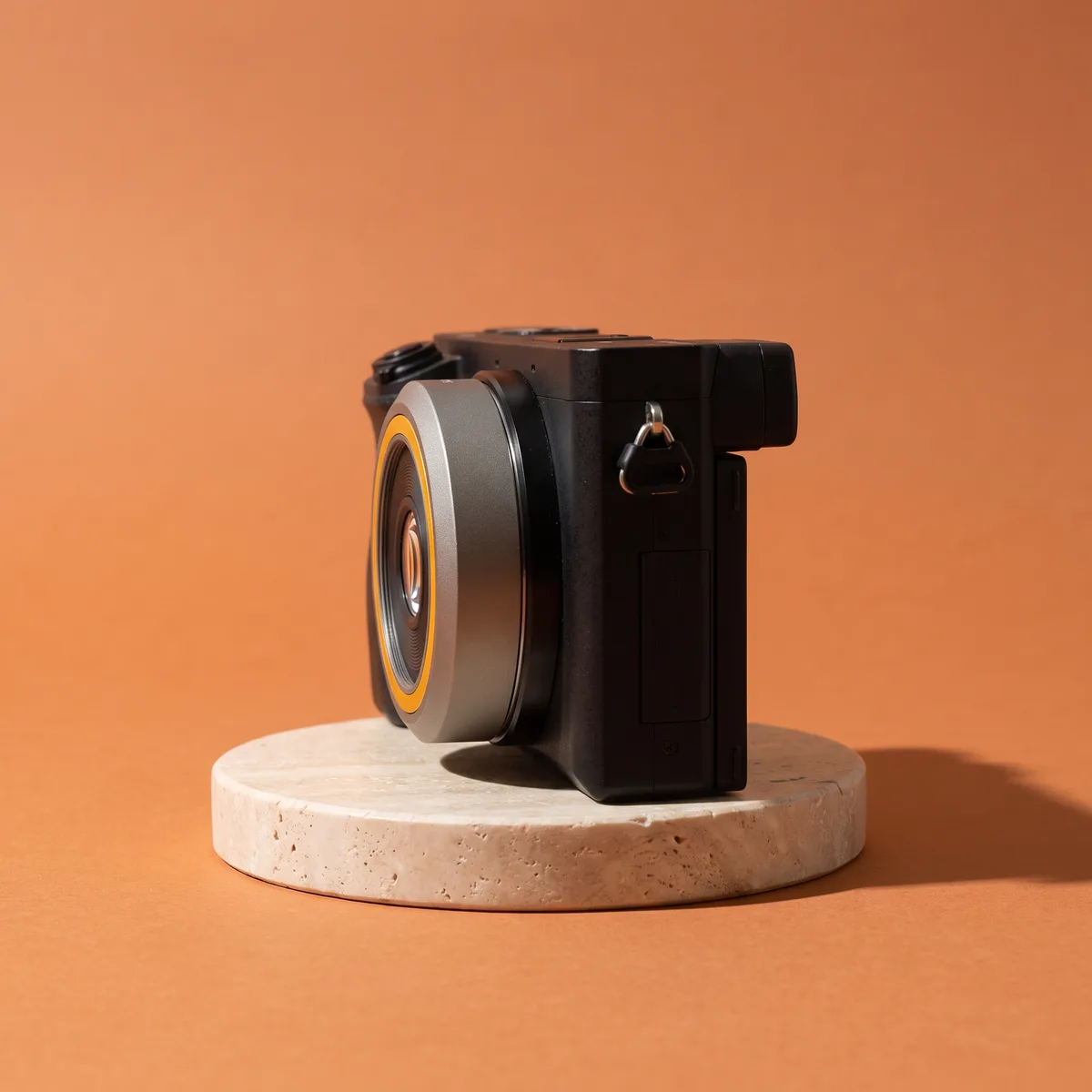
We took that lone plastic element and gave it what the home-made versions lack: a precise housing that holds it square to the sensor, and a proper fitting for your camera type. The marigold ring is there so you can find it at the bottom of a bag.
There are no controls. Focus is set at the factory, the opening never changes, and there is no chip to charge or update. It is about as thick as two coins stacked, so it can live on the camera.
- Focal length
- 28mm
- Aperture
- f/8, fixed
- Sharp from
- 1 m to infinity
- Depth
- about 2.5 cm
Money
Five routes to the look, priced
Every route below gets you somewhere near the snapshot feel. They differ in what you spend and in how much of the work happens after the shot.
| Route | Rough spend | Our take |
|---|---|---|
| A filter app or preset pack | $0 to $30 a year | Changes colour; leaves the optics untouched |
| Hunting a second-hand lens | $70 to $150 plus a converter | Real character, slow and fiddly to shoot |
| A diffusion filter | About $45 | Soft glow, corners stay bright |
| A roll of film and processing | About $25 per roll | The real thing, paid frame by frame |
| Larkspell Snapshot Lens | $45, once | All four fingerprints, in camera |
All prices on this page are invented for the demonstration and rounded on purpose.
Readers
What people say after a month
Illustrative comments written for this demonstration.
First weekend with it I shot a whole roll's worth of the kids in the garden. It felt like playing, not working.
Weekend shooter · illustrative
I leave it on the camera in my bag now. It is basically a cap that takes pictures.
Commuter · illustrative
My friends asked which app I used. None, which was the fun part.
Casual creator · illustrative
Not what I use for client work, and it is not meant to be. It is the fun lens.
Part-time photographer · illustrative
Honesty
Where it struggles
You print big
Large prints show how loose the edges are. Small prints and screens suit it.
You need straight lines
Buildings and interiors bend and soften toward the frame edge.
You love blurred backgrounds
At f/8 and 28mm most of the scene stays in focus. Look at a fast portrait lens instead.
You want one lens for everything
This is a second lens with one personality, not a replacement for your main one.
Before you order
Reader questions
Will my camera fire with it?
Yes, after one menu change. The lens carries no chip, so allow the camera to release the shutter with no lens detected. You only do this once.
Which camera types does it suit?
Mirrorless bodies in four fitting families, listed below. Your manual names the fitting your camera uses.
Can I shoot clips with it?
Yes. With nothing to focus, there is no focus noise and no hunting, so it suits short handheld clips.
What is in the box?
The lens, front and rear caps, 12 colour recipes and a microfibre cloth.
Last step
Pick your camera type and check out
Choose the fitting family your camera belongs to. It preselects in the checkout card below, and the 60-day returns cover a wrong guess.
- Full-frame mirrorlessLarger-sensor mirrorless bodies
- Crop-sensor mirrorlessCompact and travel mirrorless bodies
- Small-sensor system camerasPocketable interchangeable-lens bodies
- Digital rangefindersRangefinder-style bodies with a bayonet fitting

Demo checkout
Larkspell Snapshot Lens
28mm, around f/8, sharp from 1 m to infinity. $45 with 12 colour recipes and a microfibre cloth. 60-day returns.
Your camera type
Nothing on this property can be bought. It is a demonstration.